
Building Connections with Excellence

Fresh from the Press

Early Christianity and the Challenge of Writing History
Insights from Autofictional-Retrospective Approaches
The Content
The book suggests that the greatest challenge in writing the history of early Christianity is not the scarcity of sources but the historian's own assumptions, intellectual habits, and personal involvement in interpreting them. The book proposes a new historiographical model—autofictional retrospection—that invites historians to acknowledge their own position within the writing of history rather than conceal it behind claims of complete objectivity.
Moving beyond both traditional event-based history and reception history, the study develops a retrospective methodology that begins from the present and consciously reconstructs the past through layers of memory, interpretation, and historical imagination. Archaeology, cognitive science, literary theory, philosophy, and personal reflection are brought into dialogue to rethink historical method.
The book explores a series of interconnected themes—space, absence, silence, cognition, time, scholarship, evidence, tradition, and the future—arguing that history is not merely the recovery of past facts but an ongoing, creative, and self-reflective process. Throughout, autobiographical episodes serve not as digressions but as methodological demonstrations of how personal experience shapes historical inquiry. The result is a call for a more transparent, courageous, and intellectually self-critical historiography that extends well beyond the study of early Christianity.
Publisher: Cambridge University Press
Publishing Date: 15. Januar 2026
Length: 354 pp.
ISBN-10 : 1009638203
ISBN-13 : 978-1009638203
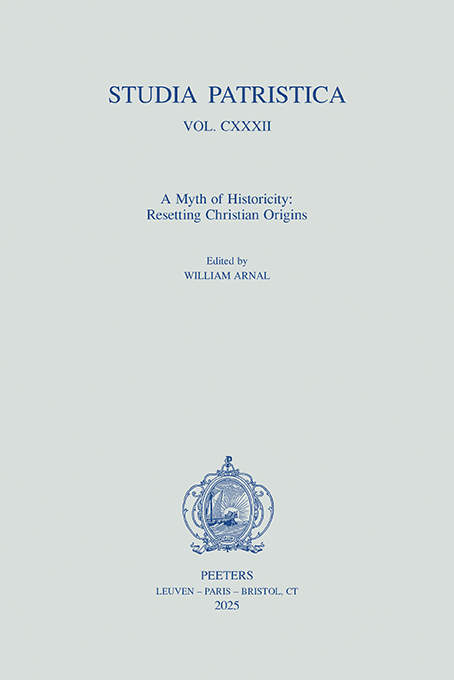
A Myth of Historicity.
Resetting Christian Origins
Edited by
William E. Arnal
Studia Patristica, 132
Edited by W. Arnal, this volume brings together essays first presented at a review panel devoted to Markus Vinzent’s provocative Resetting the Origins of Christianity: A New Theory of Sources and Beginnings (Cambridge University Press, 2023).
Opening with an introduction to the book’s principal theses and their implications for the study of Christian origins, the volume puts Vinzent’s reconstruction to the test.
Its contributors examine the later dating of New Testament writings; the formative rôle attributed to Marcion in the emergence of both the Gospel and the Pauline Ten-Letter Collection of his “New Testament”; and the significance of Josephus’ Antiquitates Judaicae and the Didache as alternative points of comparison. A further contribution investigates the possible Pauline imprint on the Gospel of Mark.
The essays combine recognition of the book’s far-reaching challenge to established accounts of Christian beginnings with critical scrutiny of its arguments, gaps and unresolved questions. A concluding bibliography provides an overview of Vinzent’s contributions to the study of Christian origins.
For more publications: